10DLC vs Short Code vs Toll-Free: Which Texting Route Actually Fits Your Volume
The short version
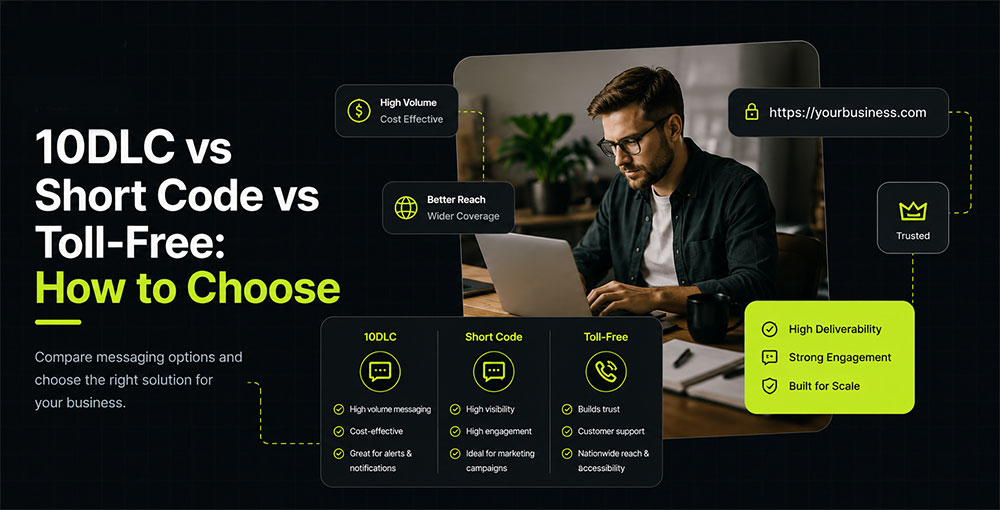
- The 10DLC vs short code decision usually comes down to volume and budget, not features. Short codes cost roughly ten to twenty times more per month and take far longer to provision.
- 10DLC uses standard local 10-digit numbers, registered through The Campaign Registry as a brand plus one or more campaigns.
- Toll-free messaging is a separate system with its own verification process. It is not part of 10DLC and does not use The Campaign Registry.
- Throughput is the real differentiator. Short codes handle the highest sustained sending rates, toll-free sits in the middle, and 10DLC speed depends on your brand trust score.
- Unverified traffic on any of the three routes is now blocked outright by major US carriers rather than merely filtered.
- Most businesses under a few hundred thousand messages per month land on 10DLC. Short codes make sense at genuine enterprise scale or for high-speed one-time-passcode delivery.
If you are setting up business texting in the United States, you have three number types to choose from, and the marketing material for each will happily tell you it is the best option. It is not that simple. Each route sits behind a different registry, a different approval process, and a very different price tag.
This guide walks through 10DLC vs short code vs toll-free on the things that actually change your day to day: what it costs, how long you wait, how fast you can send, and what gets your traffic stopped.
What each number type actually is
10DLC
A 10DLC is an ordinary 10-digit local number, the same format as any US phone number, approved for application-to-person messaging. The “10DLC” label refers to the framework, not to some special class of number.
To use one for business texting you register in two layers with The Campaign Registry: a brand, which is your verified business identity, and a campaign, which describes the specific use case you intend to send. Both have to be approved before traffic flows. If the two-layer model is new to you, our guide on what 10DLC registration involves covers it in plain terms.
Local area code, recognizable format, and the same number can take voice calls. That last point matters more than people expect, because customers do call back.
Short code
A short code is a five or six digit number, the kind you see in “Text JOIN to 55555” campaigns. You lease it, you do not own it, and the lease runs through the Short Code Registry rather than through The Campaign Registry.
Short codes are provisioned per carrier and vetted per program. That vetting is thorough and slow, but it buys you the highest and most predictable sending rates available.
Toll-free
A toll-free number uses an 800, 833, 844, 855, 866, 877, or 888 prefix. Toll-free messaging is often described as a lighter version of 10DLC, which is misleading. It is a genuinely separate system with its own verification process run through the toll-free ecosystem, and none of it touches The Campaign Registry.
You still submit business details, opt-in evidence, and sample messages. The form is shorter, but the review is real, and unverified toll-free traffic is blocked.
The comparison that matters
| 10DLC | Short code | Toll-free | |
|---|---|---|---|
| Number format | Local 10-digit | 5 or 6 digit | 800, 833, 844, 855, 866, 877, 888 |
| Registry | The Campaign Registry | Short Code Registry | Toll-free verification |
| Typical setup time | Days to a few weeks | Two to three months | Days to a few weeks |
| Monthly cost | Low, often a few dollars per number | Several hundred to over a thousand | Low |
| Sending speed | Tiered by brand trust score | Highest and most consistent | Moderate, fixed |
| Voice on same number | Yes | No | Yes |
| Best fit | Most small and mid-sized senders | High-volume enterprise, OTP delivery | Support lines, national brands without local presence |
Setup times and pricing move around — treat the table as shape rather than gospel.
The relative ordering has been stable for years even as the specifics shift.
Throughput is where the decision is really made
Cost gets all the attention. Throughput is what people actually regret.
Throughput is the rate at which the carriers will accept your messages, and it is the reason a perfectly approved campaign can take four hours to push a send that you expected to finish in ten minutes.
On 10DLC, your rate is not fixed. It is tied to a trust score assigned to your brand, based on how completely you verified your business, how long you have been sending, and how your recipients react. Carriers apply this differently: some meter messages per second, others apply daily volume ceilings by tier. A thinly verified sole proprietorship and a fully vetted established company can hold identical approvals and send at wildly different speeds. Our breakdown of 10DLC throughput explains what moves that number.
Short codes sidestep the tiering entirely. You get high, predictable, sustained rates, which is precisely why banks and large retailers keep paying for them. When you need to deliver a hundred thousand one-time passcodes in a few minutes, nothing else is comparable.
Toll-free throughput sits between the two and is generally fixed once verified. It is fine for support conversations and steady notification traffic, and it becomes a bottleneck the moment you try to blast a promotional campaign to a large list.
The practical test: divide your largest single send by the number of minutes you can tolerate it taking. If that number is uncomfortable on 10DLC, the extra cost of a short code is buying you something real.
Where each one goes wrong
10DLC goes wrong when the traffic drifts from the registration. A campaign approved for appointment reminders that starts carrying promotions is out of scope, even though every message is legal and every recipient consented. Carriers compare live traffic against your registered samples, so the mismatch surfaces on its own. Getting the filing right the first time avoids most of this, and our notes on campaign approval best practices cover the six things reviewers consistently check.
Short codes go wrong on timeline and lock-in. Two to three months of provisioning is not unusual, the lease renews on the carrier’s terms, and if you let it lapse the number goes back into the pool. Businesses that built brand recognition around a short code find that genuinely painful.
Toll-free goes wrong on perception. Toll-free numbers carry heavy voice spam associations, which shows up in reply rates. It also has a real filtering reputation problem, because the route was abused for years before verification became mandatory.
Rules that apply no matter which you pick
Choosing a number type does not change your compliance obligations. All three sit under the same requirements:
- Consent before sending. Marketing messages need prior express written consent, collected specifically for text messaging. Consent buried in linked terms does not count.
- Working opt-out handling. Under FCC rules effective April 2025, consumers may revoke consent by any reasonable means, not only by replying STOP, and revocation must be honored within ten business days.
- HELP responses that return your brand name and a way to reach a person.
- Content restrictions. The SHAFT categories plus cannabis, gambling, and loan offers are restricted or prohibited across every route. The CTIA Messaging Principles and Best Practices is the industry document carriers work from.
- No public URL shorteners. Shared shortening domains inherit everyone else’s reputation, including the spammers.
If you are still deciding whether registration applies to you at all, start with whether US A2P registration is required. The short answer is yes, for essentially all business texting.
How to actually choose
Work through it in this order.
- Estimate your largest single send and your monthly volume. Not your average. Your peak.
- Check whether speed is a business requirement. Passcodes, fraud alerts, and time-sensitive notifications have a hard deadline. Marketing usually does not.
- Decide whether customers will call the number. If yes, that rules out short codes.
- Look at your budget honestly. Short code costs are recurring and substantial, and they do not scale down.
- Consider whether local presence helps. A local area code often outperforms toll-free on engagement for regional businesses.
For most senders under a few hundred thousand messages a month, 10DLC wins on cost, flexibility, and the fact that the number works for voice too. Short codes earn their price at genuine enterprise scale. Toll-free suits national brands running support and notification traffic where a local area code would be arbitrary.
Conclusion
The 10DLC vs short code vs toll-free question is not really about features. All three deliver text messages, all three require verification, and all three block you if your consent practices are sloppy. What separates them is how fast you can send, how much you pay for the privilege, and how long you wait to start.
Pick based on your peak send volume and your tolerance for it taking a while. If 10DLC throughput comfortably covers your largest campaign, the extra spend on a short code buys headroom you will not use. If it does not, no amount of registration tuning closes that gap, and you should budget for the upgrade rather than fight it.
Once you have settled on a route, the next decision is who files on your behalf. Every platform submits to the same registry under the same rules, so the differences sit elsewhere. Our provider comparison lays out what actually varies.
Frequently asked questions
A 10DLC is a standard 10-digit local number registered through The Campaign Registry, while a short code is a leased five or six digit number provisioned through the Short Code Registry. Short codes cost significantly more per month, take roughly two to three months to provision, and deliver much higher sending rates. 10DLC is cheaper, faster to set up, and supports voice calls on the same number.
No. Toll-free messaging runs on a separate verification system and does not use The Campaign Registry. The two are often grouped together because both became mandatory around the same time, but the registration processes, the reviewers, and the throughput rules are all different.
10DLC generally performs better for marketing to a regional audience because a local area code sees stronger engagement and toll-free numbers carry spam associations from voice. Toll-free can make more sense for national brands with no meaningful local presence, or where a single recognizable support number matters.
Yes, but it is a fresh registration rather than a transfer. You register a brand and campaign with The Campaign Registry, provision new local numbers, and migrate your traffic. Plan for overlap so in-flight conversations do not break, and tell existing subscribers the number is changing.
Yes. Short codes go through per-carrier program vetting rather than The Campaign Registry, and that review is more demanding than 10DLC campaign approval, not less. The difference is which body reviews you, not whether you get reviewed.
It depends on your brand trust score rather than being a fixed number. Carriers meter differently, some by messages per second and some by daily ceilings, and a more completely verified brand with a clean sending history gets substantially more headroom than a thinly verified one.
10dlcinfo.com is independent and not affiliated with any provider, carrier, or registry. This is general information, not legal advice.